
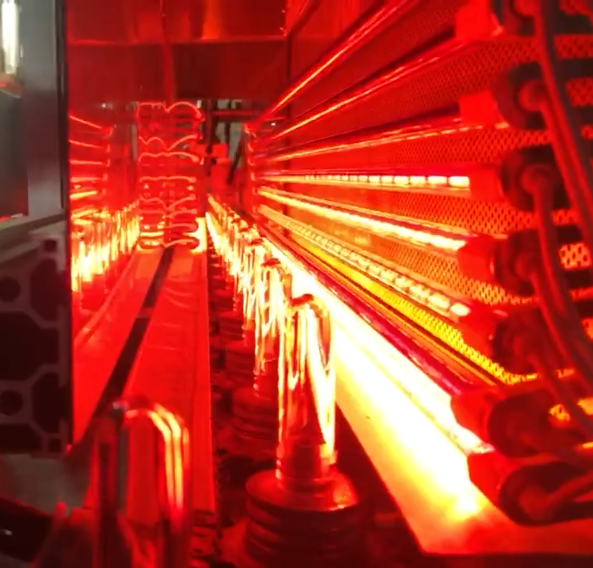
On the line, a blow molder is only as steady as its heating tunnel. When preform temperature starts to drift, stretch goes all over the place. You end up with uneven walls, weak bottles, and scrap that just keeps stacking up. Standard halogen emitters burn out fast and lose output over time, which means you’re constantly chasing setpoints and changing lamps before you’d like. What matters, technically We built this near infrared (NIR) tube for real blow molding duty. It puts out rapid, focused radiant heat with a tight spectral profile that matches PET absorption—so the preform surface heats quickly without cooking the core. Ratings are 1.5–3.0 kW, 230 V or 400 V, in compact lengths that drop straight into existing reflector housings. The quartz envelope is made to handle thermal shock, and the R7s connector lines up with the mounting hardware you see on Sidel, Krones, SIPA, Husky, SACMI, and Nissei ASB machines. Output stays stable for long stretches—we’ve got units running 5,000+ hours with under 5% drop. Why it works in stretch blow molding Time is money, and NIR tubes come up to temperature fast. That gives you quicker cycle response and repeatable preform heating across the tunnel. The payoff shows up as fewer rejects from uneven stretch, tighter bottle geometry, and less downtime for lamp changes. Energy use stays tight too: the emitter heats on demand, and the reflector keeps the energy aimed where it needs to be. You get more consistent output per kilowatt, and fewer temperature swings when you ramp line speed. A few practical details NIR heating is line-of-sight, so reflector cleanliness and positioning are non-negotiable. Check reflector geometry, lamp spacing, and voltage at the terminal. If your blow molder runs long cycles at very high output, confirm cooling and clearance around the tube—heat buildup will shorten any emitter life. Match wattage and dimensions to the OEM profile; a mismatched lamp changes heating density and can throw off your preform temperature profile. Installed correctly, the NIR tube is a straightforward upgrade that pays back through stable quality and fewer service calls.